
Introduction Have you ever noticed?
On Facebook, our hands don’t tremble to send a ‘Friend Request’ to known or even unknown people. But on Instagram, we think ten times before ‘Following’ someone. Why? Two buttons at our fingertips—one says “Add Friend”, the other “Follow”. Yet, the psychological weight of these two words is completely different. Today, we will explore why our brain and ego behave so differently on these two platforms.
1. The Word Game: Friendship vs. Following (Semantics of Equality)
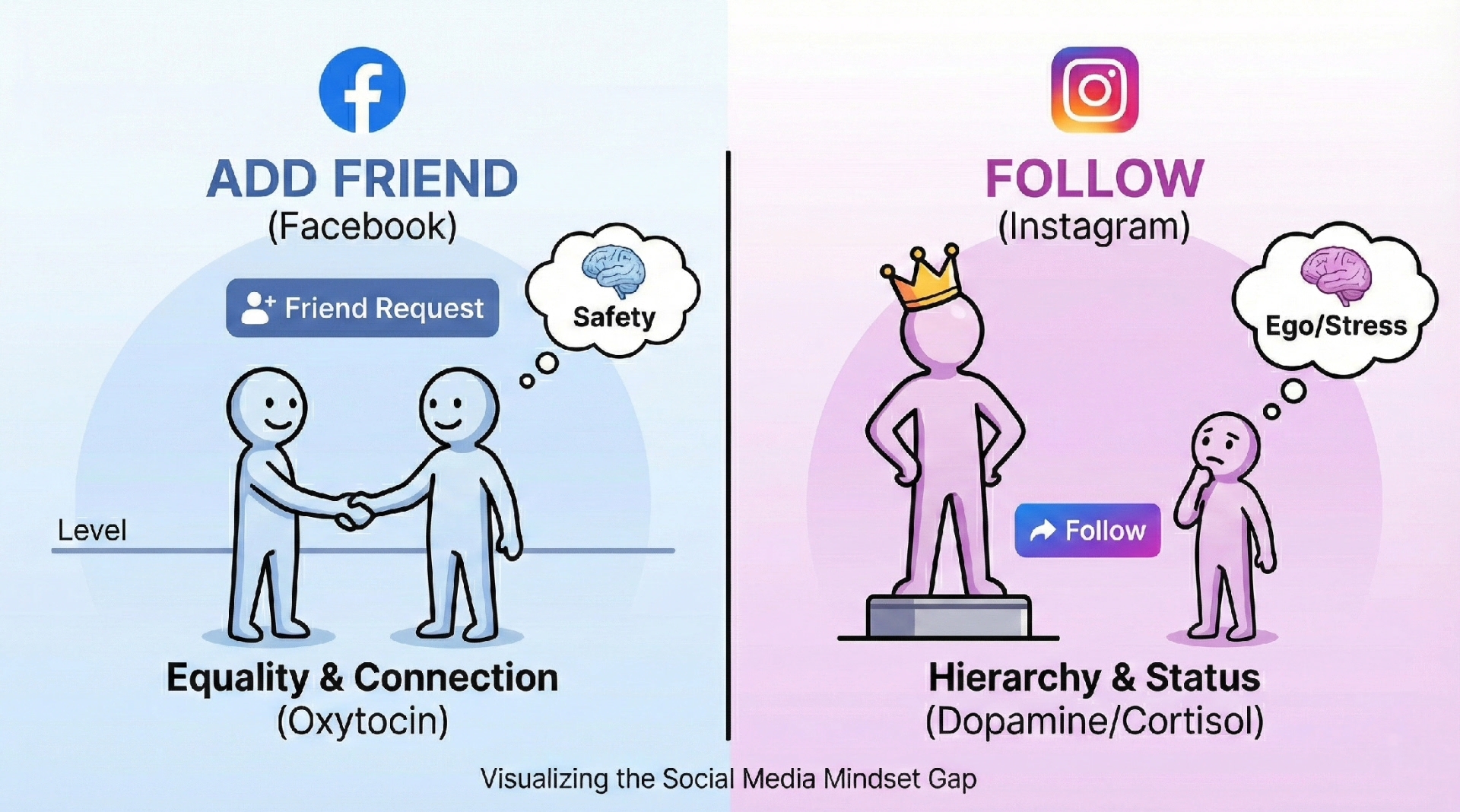
Psychologically, the word “Friend” is a symbol of equality. When you send a friend request to someone and they accept it, you both stand on a level playing field (Horizontal Relationship). Here, no one is big or small.
On the other hand, the word “Follow” implies trailing behind or pursuing. Subconsciously, this creates a ‘Hierarchy’ (a high-low dynamic). To follow someone means—you are the audience, and they are the star. You are the listener, and they are the speaker. The human Ego does not easily want to accept itself as ‘below’ or as a ‘follower’ of someone else. That is why we cannot easily press the follow button.
2. The Battle of Ego and Status (The Ego & Status Game)
Platforms like Instagram or Twitter are designed based on “Social Status.” Here, how many ‘Followers’ you have versus how many people you are ‘Following’—this ratio is an invisible social currency.
-
Follower/Following Ratio: People want their follower count to be high, but their following count to be low. This expresses a kind of aristocracy or exclusivity.
-
Fear of Rejection: If I follow someone and they don’t ‘follow back,’ I feel diminished in their eyes. This fear of Social Rejection hurts our ego. This fear doesn’t exist on Facebook because the relationship there is mutual.
3. Brain Chemistry: The Neurological Perspective
Neurotransmitters in our brain play a massive role behind our behavior:
-
Oxytocin: When a friendship is formed on Facebook, our brain receives a signal of ‘Social Bonding.’ It releases Oxytocin, a hormone that makes us feel safe and connected.
-
Dopamine and Cortisol: On Instagram, the game is about Dopamine. When we gain followers, Dopamine (the happiness hormone) is released. But when we follow someone and do not get a return (follow back), the brain releases mild stress or Cortisol. The brain always wants to avoid this mental stress, so it discourages us from following unnecessarily.
4. Reciprocity or Mutual Exchange
In the history of human evolution, “Reciprocity” (mutual exchange) is vital. Since ancient times, humans have survived by helping one another.
Facebook’s system is built on this principle of ‘Reciprocity.’ You extend a hand, the other side grabs it. The deal is done. But on Instagram, there is no such guarantee. There, following someone means you are giving them your ‘attention’ for free. Human psychology asks, “Why should I give if I don’t get anything in return?” This mentality keeps us from pressing the follow button.
5. Conclusion: We Want Connection, But on Conditions
At the end of the day, we are all social beings. We crave connection. But that connection must come with respect. On Facebook, we seek “Community”, where everyone is equal. On Instagram, we seek “Validation”.
Our ego always wants to feel important. Therefore, until we are sure that the person on the other side gives us equal importance (by Following back), our finger will hesitate to touch that blue button. This is not a technical problem; it is purely a game of human ego.