
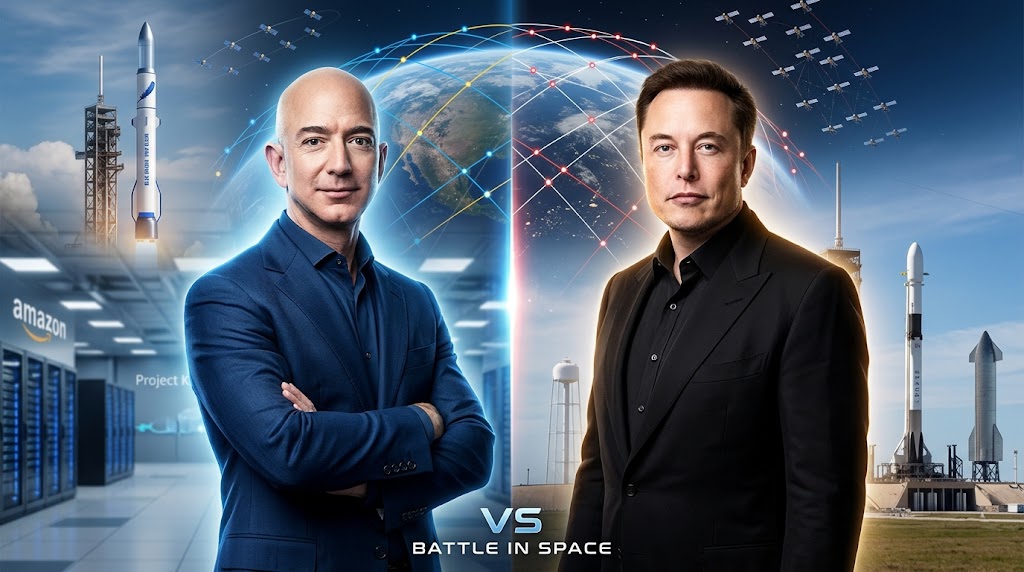
If any single subject currently dominates the world of technology, it is the battle for space between two tech giants: Amazon vs Starlink. And Jeff Bezos’s Amazon has just poured fuel on this fire. In a direct challenge to Elon Musk’s Starlink in the satellite internet space, Amazon is set to acquire satellite company Globalstar in a massive $11.57 billion deal.
This isn’t just a simple change of corporate ownership; it is a master plan that could completely reshape the future of global internet infrastructure. But why did Amazon invest such a staggering amount? And how big of a threat is this to Starlink? Let’s dive into a deep analysis of the entire situation.
The Real Reason Behind the Deal: Project Kuiper
For the past few years, Amazon has been trying to enter the Low-Earth Orbit (LEO) satellite internet market through Project Kuiper. However, building satellites, launching them, and securing global licenses is an incredibly time-consuming process. Meanwhile, Elon Musk’s Starlink had already established a near-monopoly in the market.
By acquiring Globalstar, Amazon essentially gets a “ready-made” infrastructure. Globalstar already holds crucial radio frequency licenses and operates an active satellite network. As a result, Amazon doesn’t have to start from scratch—they can jump straight into the battlefield.
A Massive Blow to Starlink’s Monopoly
Currently, Starlink is the undisputed king of the satellite internet market. They have over 10,000 satellites orbiting the earth and boast a user base of over 9 million globally. Until now, no other company could even come close to Starlink’s dominance.
But Amazon is no ordinary competitor. They have massive financial backing and own one of the world’s most powerful cloud networks—AWS (Amazon Web Services). The combination of Globalstar’s satellite technology and Amazon’s cloud computing power is going to be a massive headache for Starlink. The monopoly that Elon Musk has enjoyed so far is about to face severe competition from Jeff Bezos’s empire.
The Game-Changer: Direct-to-Device (D2D) Technology
The most fascinating and revolutionary aspect of this deal is Direct-to-Device (D2D) Technology. Currently, to use Starlink, you need to install a large dish antenna at your home. But Amazon’s vision goes much further.
Leveraging Globalstar’s spectrum, Amazon plans to introduce technology that brings satellite internet directly to your standard smartphone—no separate antennas or special hardware required. The company has stated its goal to launch this D2D cellular coverage by 2028. If successful, whether you are on a mountain peak or deep in a jungle, the “no signal” or “no network” problem will disappear forever.
What Happens to Apple and iPhone Users?
Whenever Globalstar is mentioned, Apple naturally comes into the conversation. This is because the highly talked-about ‘Emergency SOS via Satellite’ feature on iPhones runs on Globalstar’s network. In fact, Apple invested $1.5 billion in 2024 to acquire a 20% stake in Globalstar.
So, what happens to iPhone users now that Amazon is buying Globalstar? There is no need to worry. Amazon and Apple have signed an agreement ensuring that the emergency satellite features for iPhone and Apple Watch users will continue to work seamlessly. If anything, Amazon’s massive investment will make Globalstar’s satellite network even stronger, indirectly providing iPhone users with better service.
How will ordinary users benefit from the ‘Amazon vs. Starlink’ battle?
Ultimately, the general public will be the real winners of this tech war. When Starlink faces strong competition, internet package prices will inevitably drop.
-
Potential for Lower Costs: Thanks to competition, the currently sky-high prices of satellite internet will become much more affordable for the average consumer.
-
Improved Coverage: High-speed internet will finally reach remote villages and rural areas where traditional broadband or 4G/5G networks have failed to penetrate.
-
Smartphone Evolution: Future smartphones will be inherently designed to connect directly with satellites.
The Bottom Line
This $11.57 billion Amazon-Globalstar deal proves that the primary technological battleground of the next decade will be in space. The billionaire space race between Elon Musk and Jeff Bezos is no longer just about launching rockets; it is now a race to see who can deliver uninterrupted satellite internet to your phone first.
Starlink might be far ahead in the race right now, but with a formidable opponent like Amazon entering the arena, it goes without saying that this battle is going to be fiercely competitive.
What do you think? Can Amazon truly end Starlink’s reign? Let us know your thoughts in the comments below!
[The Dark Side Effects of Extreme Digitalization]

While the technological advancements are staggering, the extreme digitalization and the race to cover the earth in satellites carry profound, devastating side effects for both the environment and human cognitive function. Here is a deep scientific analysis of the grim reality:
1. The Satellite Blanket and Silent Environmental Destruction (Space & Atmospheric Science)
The push by mega-constellations like Starlink and Project Kuiper to blanket the Earth with satellites has terrifying scientific implications:
-
Kessler Syndrome: Proposed by NASA scientist Donald Kessler, this theory warns that as the density of satellites increases, a single collision could create a chain reaction of space junk. Eventually, Earth’s Low-Earth Orbit (LEO) could become so heavily polluted with debris that humanity might be unable to launch rockets into space for centuries.
-
Ozone Layer Depletion: These satellites typically have a lifespan of 5-7 years. Afterward, they re-enter the Earth’s atmosphere and burn up. During this combustion, they release massive amounts of Aluminum Oxide gas. Recent scientific studies indicate that this chemical is severely destroying the Earth’s Ozone Layer, dramatically increasing the risks of global warming and skin cancer.
2. The Decline of Human Brain Power (Neuroscience & Cognitive Science)
When the space for independent human thought shrinks, the brain fails to develop its full potential. Neuroscience explains this perfectly:
-
Cognitive Offloading: We no longer memorize phone numbers, we rely on GPS to navigate, and we use calculators for basic math. Science shows that as we reduce the use of the hippocampus (the part of the brain responsible for memory and navigation), it physically shrinks. By offloading our cognitive tasks to machines, our brains are losing their natural capabilities.
-
Neuroplasticity and Loss of Focus: Our brains wire themselves based on how we use them (Neuroplasticity). Watching short videos or reels creates small dopamine spikes every 15 seconds. Over time, this destroys the neural circuits required for “Deep Work,” like reading a book or solving complex problems. Society is increasingly suffering from attention deficits and losing the ability to engage in critical, analytical thinking.
3. The Entertainment Trap and the Death of Protest (Psychology & Sociology)
Why aren’t people standing up against injustice anymore? The science behind this lies in the mechanization of human emotions:
-
Compassion Fatigue: Seeing hundreds of videos of war, death, corruption, and injustice on social media every day overloads the brain’s emotional center, the amygdala. To protect itself, the brain eventually stops reacting to these stimuli. People become desensitized. Even when injustice happens right in front of them, they feel emotionally numb.
-
Aldous Huxley’s “Brave New World” Theory: Philosopher and author Aldous Huxley theorized that dictators wouldn’t need force to control the masses; cheap entertainment would be enough. People become so absorbed in cheap entertainment, video games, and social media that they don’t even realize their freedom of thought is being stolen. They learn to love their own servitude.
4. The Ultimate Truth: The Law of Entropy
The reality that these negative impacts will inevitably affect everything is directly proven by the Second Law of Thermodynamics, or the Law of Entropy.
This law states that whenever work is done in a system (such as technological development), the disorder or “entropy” of that system increases. No matter how perfectly we organize the digital world, it will create an equal amount of chaos and destruction in the physical world. The massive carbon footprints of data centers, the immense electricity required to run AI, and the mountains of e-waste—these are all physical manifestations of that entropy.
We are dreaming of a digital utopia, but in reality, we are marching toward a physical dystopia.
There are many other unseen damages that haven’t been mentioned here. Stay aware, and stay healthy.