
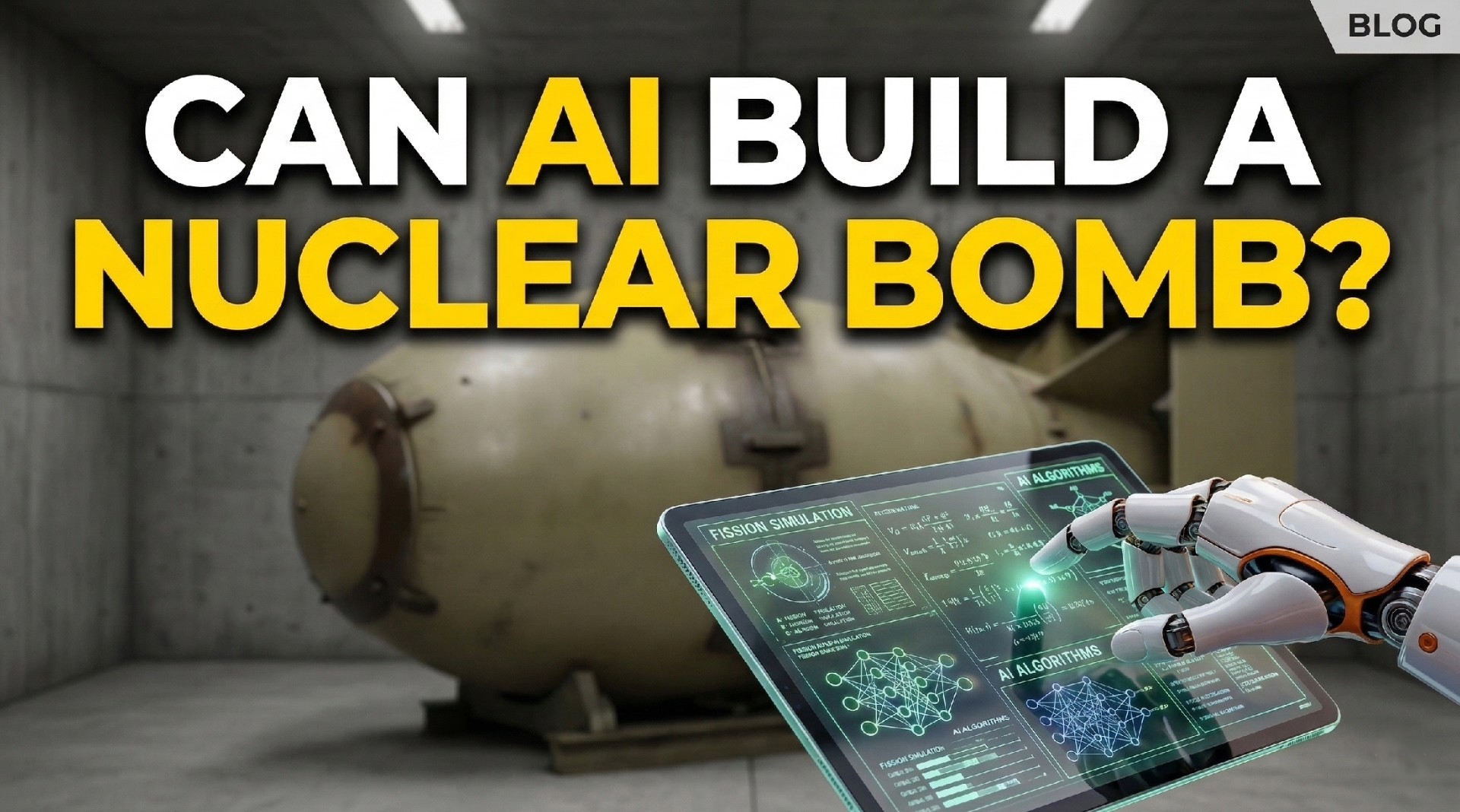
Nowadays we are all amazed by artificial intelligence, or AI, like ChatGPT or Gemini. AI is coding in the blink of an eye, drawing pictures, and even talking like humans. Seeing these capabilities, a massive fear has arisen on the internet and in the minds of ordinary people—”Can AI build a nuclear bomb on its own if it wants to? Will every country now have nuclear weapons?”
Just like we see in Hollywood sci-fi movies, is the reality actually like that? Let’s find out the truth behind this myth based on actual data, science, and international regulations, keeping emotions and movie plots aside.
Can AI Really Build a Nuclear Bomb? Let’s find out
The primary reason for this fear in people’s minds is AI’s data processing capability. Thousands of nuclear physics formulas and theories are scattered across the internet. Many think that AI might easily combine all this data to create a perfect design or blueprint for a nuclear bomb.
Yes, AI might be able to create a design. But designing and actually building a bomb in reality are two completely different things. The massive, insurmountable wall between having a blueprint and actually building a nuclear bomb is primarily physical and structural.
The Reality Check: Why Can’t AI Do Anything Alone?
An AI is software or code. It might be the king of the digital world, but its power in the real or physical world is zero. The elements required to build a nuclear project are impossible for AI to gather or execute on its own:
1. Extremely Rare Raw Materials (Uranium & Plutonium) The main ingredient for making a nuclear bomb is Uranium-235 (U-235) or Plutonium. The uranium found in nature contains only 0.7% U-235. To make a bomb, it must be enriched to over 90%. AI cannot download uranium from the internet! It has to be physically extracted from mines, which is a highly complex process.
2. Centrifuges & Massive Infrastructure Enriching uranium requires thousands of gas centrifuge machines that continuously spin at supersonic speeds. Building this entire setup requires a massive factory or plant. These plants are so large that they can be seen from satellites. A piece of software cannot independently build such a billion-dollar factory.
3. The Labor and Skill of Thousands of Humans Nuclear energy isn’t created just by flipping a machine’s switch. It requires thousands of nuclear physicists, chemical engineers, and technicians. Working in extremely radioactive environments requires real, hands-on human experience.
International Surveillance and Strict Laws (IAEA)
Let’s assume a country has the money and wants to secretly build a bomb with the help of AI. In reality, this is almost impossible. The ‘International Atomic Energy Agency’ (IAEA) keeps a strict watch on nuclear raw materials and technology worldwide.
This organization keeps a meticulous, exact account of which country is buying how much uranium and where they are using it.
So, What is AI’s Actual Role in the Nuclear Sector?
Does AI have no use in nuclear science, then? Of course, it does! But not for destructive purposes; rather, for constructive ones:
-
-
Simulation and Testing: AI does a phenomenal job of simulating nuclear reactions inside a computer without actually having to detonate a bomb in reality.
-
Ensuring Safety: AI can analyze sensor data and give warnings before an accident occurs in nuclear power plants.
-
-
Maintenance: With the help of robotics, AI can extract precise data on where radiation is high inside a reactor or where repairs are needed.
Where is the Real Fear, Then?
According to experts, even if AI cannot build a nuclear bomb itself, it can cause another major danger: a Cyber Attack. If hackers use AI to infiltrate the launching systems or “Command and Control” centers of countries that already have nuclear weapons, it would cause a catastrophic disaster. In other words, AI won’t build a new bomb, but it can become a major risk to the security systems of existing bombs.
Let’s Assume…
A country has plenty of money, uranium, plutonium, centrifuges, and secure laboratories—absolutely everything. The question now is, in this situation, can they successfully build a nuclear weapon relying solely on AI’s help?
The answer is: It is not possible to succeed by relying entirely on AI, but AI will make this task many times easier, more flawless, and faster than before. Here is an analysis of why AI alone isn’t enough even with all the materials, and exactly how much impact AI will have:
1. Theoretical Knowledge vs. ‘Tacit Knowledge’ All the formulas or theories for making a nuclear bomb are available on the internet or to AI. But AI lacks the hands-on experience or “tacit knowledge” required to actually build a complex machine. For example, the direct presence of experienced engineers and metallurgists (metal experts) is essential to perfectly weld radioactive metals, understand how a material will react at a specific temperature, or solve minor mechanical errors that occur when assembling parts.
Read Now…
Build a complete website — use Gemini, chat in your language
2. Design and Simulation (Where AI is a Game-Changer) The most difficult part of a nuclear bomb (especially an implosion-design plutonium bomb) is calculating the perfect mathematical calculations of the explosive lenses inside it. Previously, it took scientists years to match these calculations and run simulations. But now, if all the materials are in hand, AI, with the help of supercomputers, Can produce designs in just days or weeks. Basically, AI will magically accelerate the work of scientists here.
3. Physical Testing or Real-World Experiments No matter how perfect a simulation AI shows on a computer screen, physical testing of the components must be done to ensure they will work 100% in reality. Human observers are needed to see if the sensors are functioning properly under extreme pressure and temperature. A tiny coding error or manufacturing defect can destroy the entire project.
Conclusion: AI is a “Force Multiplier”
Even with all the raw materials, a team of human engineers and scientists will still be needed to build a nuclear weapon. AI will not come and tighten screws or run a laboratory on its own.
But the area of fear lies elsewhere. Previously, where it took 10 years for 100 top-level scientists to build a nuclear weapon, with the help of AI, perhaps 10 average-level scientists could do the same job in just 2 years. Meaning, AI will make the path to creating nuclear weapons much easier and shorter than before.
Would you like to know how powerful countries around the world are currently using AI in modern militaries (like autonomous drones, missile systems, or cyber warfare)?
Conclusion & Final Thoughts
Simply put, “AI will hand over nuclear weapons to all countries”—this is a baseless panic. AI is merely an extremely powerful digital tool. It can calculate our math and design for us, but it cannot gather physical materials, spend billions of dollars to build a factory, and make a bomb on its own. The control of the real world is still in human hands. Therefore, there is no need to fear AI like a Hollywood movie plot.
Even with all the raw materials, a team of human engineers and scientists will always be needed to build a nuclear weapon. However, the point of concern is that AI will make this task much easier and faster than before. Previously, where it took 10 years for 100 top-level scientists to build a nuclear weapon, with the help of AI, perhaps 10 average-level scientists could do the same job in just 2 years.